Pinocchio runs away and Geppetto is arrested
The Adventures of PinocchioPinocchio’s first escape from home ends not in freedom but in separation: after he runs into the street, a crowd’s unfounded suspicions lead the Carabineer to arrest Geppetto instead of returning the runaway to him. The episode joins slapstick movement to a sharp reversal, making the wooden puppet’s newfound independence the cause of his father’s imprisonment.
Circumstances and the Escape
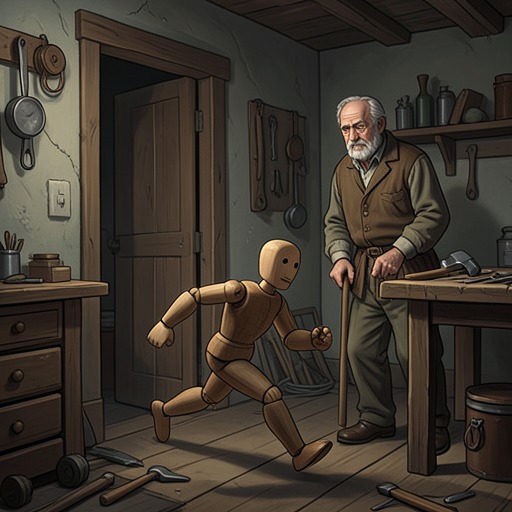
Geppetto first has to teach Pinocchio to walk. The puppet’s legs are stiff, and Geppetto holds his hand, showing him how to put one foot in front of the other. Once his legs loosen, however, Pinocchio runs around the room by himself, reaches the open door, and leaps into the street. The sudden change from a child being guided to a runaway moving under his own power gives the escape its decisive turn.
Geppetto runs after him but cannot catch him. Pinocchio’s wooden feet strike the stones loudly as he bounds away, while Geppetto shouts for people to catch him. Passersby stop to stare and laugh at the sight of a wooden Marionette running at speed. A Carabineer arrives, initially mistaking the commotion for a runaway colt, and plants himself in the street to stop it. Pinocchio tries to slip between the man’s legs but fails. When he hears that he must go home, he throws himself on the ground and refuses to take another step.
The Crowd’s Intervention
As onlookers gather, their interpretation of the chase overwhelms what has actually happened. One man calls Pinocchio a poor Marionette and assumes Geppetto will beat him; another describes Geppetto as a tyrant and warns that he might tear the puppet to pieces. The story gives no evidence for these accusations. They arise from the crowd’s speculation, which transforms Geppetto’s attempt to recover his runaway son into an apparent act of cruelty.
The Carabineer responds to the crowd by setting Pinocchio at liberty and dragging Geppetto to prison. Geppetto cannot defend himself. He weeps and laments that he had tried so hard to make Pinocchio well-behaved, then turns the blame inward, regretting that he had not thought the matter through. The immediate consequence of Pinocchio’s flight is thus reversed: the parent who pursued him is taken away, while the child remains free.
Separation and Later Recognition
The arrest establishes an early pattern in Pinocchio’s adventures: warnings and attempts to guide him repeatedly collide with his desire to act on impulse. Later, he dismisses the Talking Cricket’s advice and reasons that Assassins are only a frightening invention used by parents to keep children from running away at night. Much later, after a schoolmate is struck and lies pale and motionless, Pinocchio stays behind while the other boys flee. In his grief and fear, he acknowledges that he should have gone to school, listened to his mother and teacher, and resisted the bad influence of his companions. These later moments do not undo the first escape; they show how its disobedience belongs to a recurring sequence of defiance followed by painful recognition.
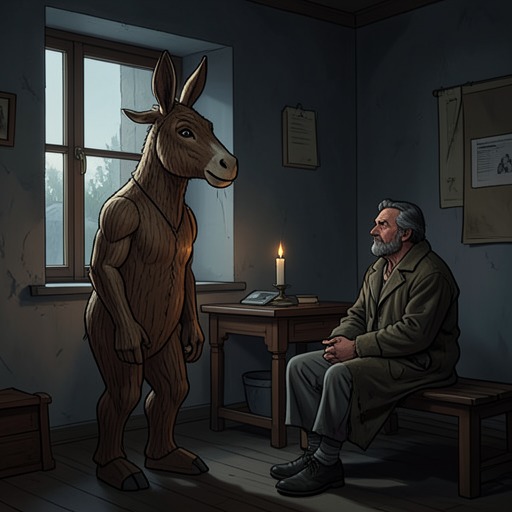
The separation also belongs to a longer father-and-son trajectory. After many intervening adventures, Pinocchio finds Geppetto again in a dark place, seated at a little dinner table by candlelight and eating live fish. Pinocchio rushes to embrace him and declares that he will never leave him again. The reunion gives the initial arrest a distant consequence: the boy who once ran out of the open door eventually returns to his father, now speaking in the language of attachment rather than escape.
Narrative Role
The scene’s comedy depends on a striking mismatch between appearance and judgment. A wooden figure races through the street, wooden feet clattering on stone, and a crowd laughs; then the same crowd treats its own imagined account of Geppetto as fact. The arrest converts a noisy public spectacle into an unjust separation, while Geppetto’s tears expose the human cost of the misunderstanding.
The episode also anticipates how Pinocchio’s body and actions will repeatedly become public spectacle. In the Marionette Theater, the performers recognize him as their brother and carry him on their shoulders, only for the Director’s fearsome entrance to silence the theater. Later, trained as a donkey, Pinocchio is advertised as a famous performer, and during a public act he spots the Fairy in the audience. These are different events, but they echo the first escape’s contrast between Pinocchio’s visible body, the people watching him, and the forces attempting to control what he does. Here, that pattern begins with a leap into the street and ends with Geppetto behind bars.